
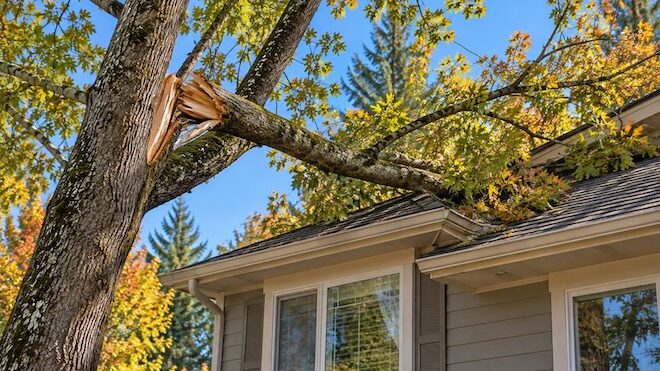
At P’n’D Logging and Tree Service, we encourage property owners throughout the Puget Sound region to pay attention to branches that could damage property or injure someone if they fail. The risk becomes especially important as we move into the wetter, windier months of fall and winter.
A Branch Does Not Have to Look Dangerous
One of the challenges with tree hazards is that a branch may appear healthy from the ground while still having a structural problem.
Dead wood is one obvious concern, but live branches can fail too. Cracks, weak attachment points, decay, previous storm damage, and excessive weight can all affect how well a branch stays attached to the tree.
The USDA Forest Service warns that damaged limbs can fall at any time and recommends watching for broken limbs, dead sections, and other structural defects.
That does not mean every unusual-looking branch is dangerous. It does mean that branches positioned over areas where people or property are regularly present deserve more attention.
Location Makes a Big Difference
A dead branch hanging over an unused section of a large property presents a different level of concern than the same branch hanging over a front entrance.
Think about what is underneath the tree.
Potential problem areas include:
- Homes and other buildings
- Roofs and gutters
- Driveways and parked vehicles
- Sidewalks and walkways
- Decks and patios
- Play areas
- Parking lots
- Customer entrances
- Outdoor work areas
The National Park Service notes that falling trees, limbs, and branches can pose risks to both people and infrastructure, particularly in developed areas. (National Park Service)
For homeowners, that might mean a branch over the driveway where the family parks every night. For a commercial property, it could be a large limb over an entrance, employee parking area, or customer walkway.
Dead and Broken Branches Need Attention
Dead branches are often easier to identify once leaves begin falling in autumn.
Look for limbs that have no leaves while surrounding branches are still holding foliage. Other signs can include missing bark, brittle-looking wood, broken ends, or branches that have become lodged in the canopy.
A branch that has already broken but remains caught in another part of the tree can be particularly unpredictable. It may stay in place for weeks or months before wind, rain, or movement in the supporting branches finally brings it down.
Large dead branches should not be treated as harmless simply because they have remained attached for a long time.
Cracks and Weak Connections Can Be Easy to Miss
Pay attention to where large branches connect to the trunk or to other major limbs.
Cracks around these connections may indicate that the branch is beginning to separate. Multiple large stems growing from the same point can also create areas that deserve closer inspection, particularly when the tree carries a large, heavy canopy.
Sometimes there are clues on the ground as well. Freshly fallen smaller branches can indicate that portions of the canopy are beginning to fail.
If you hear cracking or notice a branch suddenly hanging differently than it did before, keep people and vehicles away from the area until the situation can be evaluated.
Wind and Rain Can Increase the Consequences
Puget Sound trees regularly experience rain and wind, and healthy trees are designed to withstand normal weather.
The concern is what happens when an already weakened branch encounters those conditions.
Wet foliage can add weight. Wind can repeatedly move a weakened branch back and forth. Existing cracks may grow. Decayed wood may no longer have the strength it once did.
This is why a branch that has caused no problems for years can eventually fail during a storm or windy afternoon.
The danger is not limited to severe storms. The National Park Service cautions that branches and trees can sometimes fall even when there is little or no wind. (National Park Service)
The Damage Can Be More Than a Cleanup Job
A fallen branch on an open lawn may mean some cutting and cleanup.
A large branch landing somewhere else can be much more serious.
It can damage roofing, gutters, siding, fences, vehicles, outdoor equipment, or utility areas. On commercial and municipal properties, it can block parking areas, entrances, sidewalks, or access routes.
More importantly, falling branches can injure people.
That is why the location of a questionable branch matters as much as the condition of the branch itself. The greater the likelihood that someone or something valuable will be underneath it, the more important it becomes to address the hazard.
Look Up Before the Weather Gets Worse
Late October is a practical time to look over the trees around your property.
Check for large dead branches, broken limbs, branches hanging over buildings or frequently used areas, visible cracks, and sections of the canopy that simply do not look right.
You do not need to diagnose the problem yourself. The goal is to notice changes before a branch comes down unexpectedly.
If you see damaged or questionable branches around your home, business, or other property, P’n’D Logging and Tree Service can help determine whether tree trimming, branch removal, or another tree service is appropriate.
Addressing a hazardous branch before it falls is usually much easier than dealing with property damage or an injury afterward.