
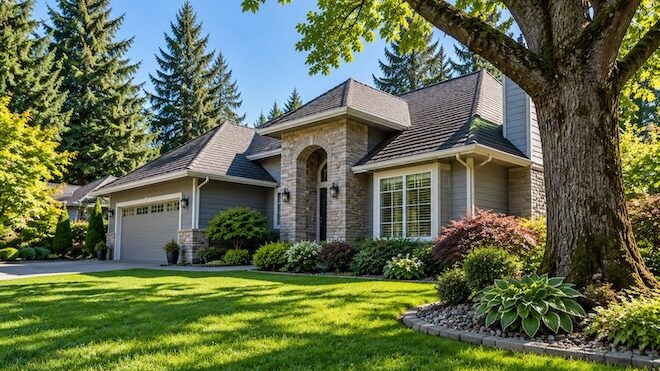
But when wind season arrives, size matters.
At P’n’D Logging and Tree Service, we encourage property owners to take a closer look at large trees before the strongest fall and winter winds move through the region. A mature tree may have handled years of storms without a problem, but that does not mean its condition has stayed exactly the same.
And when something does go wrong with a large tree, the damage can be significant.
Bigger Tree, Bigger Impact
A tall tree catches a tremendous amount of wind. Its branches move, the canopy shifts, and the trunk and root system absorb that force.
Washington State University notes that windstorms are a common source of tree damage in western Washington and can break branches, snap tree tops, or bring down entire trees. (Washington State University)
That does not mean a large tree is automatically dangerous.
Healthy mature trees can withstand plenty of wind. The real question is whether the tree already has a weakness that the next storm could expose.
Take a Quick Look Around
You do not need to climb the tree or conduct a technical inspection. Start with a simple walk around the property.
Look for things such as:
- Large dead branches
- Cracks or splits in major limbs
- A new or increasing lean
- Broken branches caught in the canopy
- Exposed or damaged roots
- Soil lifting around the base
- Areas of dieback in the canopy
- Decay or cavities in the trunk
Washington’s Department of Natural Resources identifies conditions such as leaning trunks, weak branch connections, damaged roots, flooding, and wind damage as factors that can contribute to hazardous trees. (Washington Department of Natural Resources)
One warning sign does not automatically mean the tree needs to be removed. But several signs together deserve attention.
Don’t Forget the Roots!
It is easy to focus on the branches because they are what we can see.
But roots are what keep the tree standing.
Construction, excavation, soil compaction, erosion, and drainage changes can all affect the root system. Sometimes those changes happen gradually and are easy to overlook.
Then fall rain arrives.
As soil becomes wetter and more saturated, conditions around the roots can change. Combine that with strong wind pushing against a large canopy, and an existing weakness may become much more important.
A tree can survive many storms and still develop problems later because the tree, the soil, and the surrounding property are constantly changing.
What Is Under the Tree?
This is one of the most important questions to ask.
A large tree in an open area is one thing. A large tree hanging over a house, driveway, parking lot, or busy walkway is something else entirely.
Pay special attention to trees near:
- Homes and garages
- Driveways and parked vehicles
- Sidewalks
- Customer entrances
- Parking areas
- Outdoor work areas
- Play areas
- Other frequently used spaces
The condition of the tree matters, but so does what could be hit if something fails.
More Pruning Is Not Always Better
It may seem logical that removing lots of branches would make a large tree safer in the wind.
Not necessarily.
Washington State University warns that excessive thinning can leave too much weight toward the ends of branches and may increase the potential for failure during windstorms. (Washington State University)
The goal is not simply to remove as many branches as possible.
The better approach is to identify dead, damaged, poorly attached, or problematic limbs and address the specific areas that need attention.
Pay Attention to Changes
A tree that has leaned slightly for 20 years may be completely different from a tree that suddenly started leaning last month.
Changes matter.
Ask yourself:
Does this tree look different than it did last year?
Has a large branch died? Is more soil showing around the roots? Did nearby construction change the ground around it? Was another large tree removed nearby? Did a storm damage part of the canopy?
Those changes can be more useful than simply looking at the age or size of the tree.
Before the Wind Starts Blowing
Large trees are not something property owners need to fear. Most mature trees remain strong and stable for many years.
But ignoring obvious warning signs is not a good strategy either.
A small branch falling into an open lawn may mean a little cleanup.
A large branch or mature tree falling onto a roof, vehicle, sidewalk, or parking area is a very different situation.
Take a look before wind season really gets going!
If something seems different, damaged, or questionable, P’n’D Logging and Tree Service can help determine whether tree trimming, tree removal, or another service makes sense for your property.