
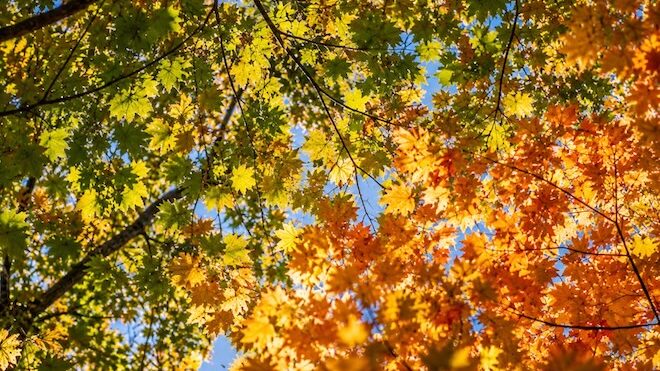
At P’n’D Logging and Tree Service, we recommend looking at the overall pattern of leaf change rather than assuming every yellow or brown leaf signals a problem. Some changes are simply seasonal. Others may point to stress, disease, damaged branches, or declining tree health.
Early Leaf Drop Can Be a Warning Sign
Leaves that begin dropping well before surrounding trees of the same type may deserve a closer look.
Premature leaf drop can be associated with environmental stress, including drought, excessive moisture, root problems, or other growing conditions. Washington State University notes that premature leaf drop can be a sign of tree stress.
One unusual season does not necessarily mean a tree is in serious trouble. A repeated pattern over several years is more concerning.
Look at the Whole Canopy
The pattern of leaf loss matters.
A tree that changes color evenly across the canopy may simply be responding to the season. But if one large branch loses its leaves much earlier than the rest of the tree, that section may be damaged or declining.
Watch for:
- One side of the tree losing leaves first
- Bare sections surrounded by healthy foliage
- Individual branches with brown or curled leaves
- Noticeably thinner areas in the canopy
- Large differences between similar trees growing nearby
Unusual Color Can Provide Clues
Fall color varies considerably between tree species, so yellow, orange, red, or brown leaves are not automatically cause for concern.
Timing and location matter more.
Leaves changing color unusually early, especially during late summer or early fall, may indicate that the tree experienced stress during the growing season. Likewise, leaves on only one branch turning brown while the rest of the tree remains healthy can point to a localized problem.
Weather also affects fall color, so color alone should never be used to judge tree health.
Evergreens Lose Foliage Too
Evergreen does not mean that every needle remains on the tree permanently.
Many conifers naturally shed older interior needles in the fall. Washington State University explains that normal seasonal needle loss generally affects older needles toward the inside of the tree, while newer growth at the branch tips remains green.
That is quite different from seeing entire branches turn brown or newer outer needles die.
Leaf Drop Is Only One Piece of the Picture
Leaves can provide useful clues, but they should be considered along with the rest of the tree.
If unusual leaf loss is accompanied by cracked limbs, dead branches, cavities, fungal growth, damaged bark, or changes around the roots, the combination may deserve professional attention.
This is particularly important when a large tree is close to a home, driveway, sidewalk, parking area, or other frequently used space.
Pay Attention to Patterns
October is a good time to notice how trees are transitioning into fall. Rather than worrying about every falling leaf, look for changes that seem unusual compared with previous years or with similar nearby trees.
Early leaf loss, uneven canopy thinning, isolated dead sections, or abnormal discoloration can provide useful warning signs.
If you notice unusual changes in the trees on your property, P’n’D Logging and Tree Service can help determine whether the tree simply reflects normal seasonal change or whether pruning, tree removal, or another tree service may be needed.