
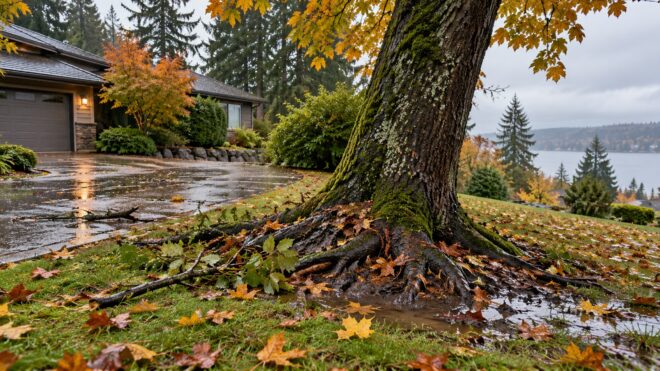
At P’n’D Logging and Tree Service, we recommend paying attention to changes around your trees as the rainy season begins. Some warning signs are easy to spot once you know what to look for.
Saturated Soil Can Affect Tree Stability
Tree roots depend on the surrounding soil for support. After extended periods of rain, soil can become saturated and lose some of its ability to hold roots firmly in place.
The USDA Forest Service notes that saturated soil can contribute to root loosening and windthrow, particularly when other factors such as shallow roots, damaged roots, or strong winds are involved.
Watch the ground around larger trees for:
- Newly raised or cracked soil
- Mounds or ridges near major roots
- Exposed roots
- Gaps developing between the trunk and surrounding soil
- Areas where the ground appears to be lifting
These changes can indicate that the root system is moving.
A New Lean Deserves Attention
Not every leaning tree is dangerous. Some trees have grown at an angle for decades and have adapted to that position.
A tree that has recently started leaning is different.
If a tree appears to be leaning more than it did before, especially after several days of heavy rain, take a closer look at the ground around its base. Soil movement or lifting roots can indicate that the tree is becoming less stable.
This is particularly important when the tree could fall toward a house, driveway, parking area, sidewalk, utility line, or another frequently used area.
Standing Water Can Point to Root Problems
Water collecting around a tree does not automatically mean something is wrong, but consistently saturated soil can create problems.
Washington State University explains that tree roots need both moisture and oxygen. When soil remains saturated, the amount of oxygen available to roots is reduced.
Poor drainage, compacted soil, changes in grading, and construction around a property can all affect how water moves through the root zone.
If water regularly pools around a tree after rainfall, it may be worth determining whether drainage conditions have changed.
Rain Can Make Existing Damage Easier to Spot
Fall weather can also draw attention to problems that were already developing.
Look for:
- Cracks or splits in the trunk
- Large dead branches
- Broken or hanging limbs
- Cavities or areas of decay
- Mushrooms or fungal growth around the base
- Loose or damaged bark
- Branches resting on roofs or structures
One individual sign does not necessarily mean a tree needs to be removed. Several warning signs together, however, may indicate that the tree should receive closer attention.
Check Trees After Periods of Heavy Rain
You do not need to inspect every tree after every rainstorm. The better approach is to become familiar with how the trees on your property normally look.
After an extended period of heavy rain, walk around the property and look for anything that has changed. A new lean, freshly exposed roots, cracked soil, or a large damaged limb deserves more attention than something that has looked the same for years.
The return of fall rain can provide an early warning of problems before stronger winter weather arrives.
If you notice a tree that has shifted, developed visible damage, or appears unstable, P’n’D Logging and Tree Service can help evaluate the situation and determine whether pruning, tree removal, or another tree service is appropriate for your Puget Sound property.