
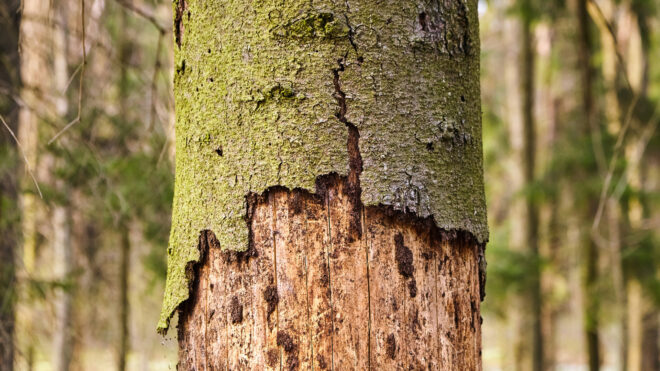
That does not mean every dead tree will fall tomorrow. How quickly a tree needs to be removed depends on its size, condition, location, and what could be damaged if part or all of the tree fails. At P’n’D Logging and Tree Service, we look at the entire situation before determining how urgently a dead tree should be addressed.
Why Dead Trees Become More Dangerous Over Time
A living tree can respond to injuries and maintain new growth. Once the tree dies, that process stops. Weather, decay, insects, and normal deterioration can continue to affect the wood and root system.
One of the first concerns is often the canopy. Dead limbs may become loose and fall without bringing down the entire tree. The International Society of Arboriculture identifies dead branches as an obvious potential tree hazard, especially when a large branch is located over an area where people, vehicles, or structures could be hit.
The trunk and roots also matter. Cracks, cavities, decay, damaged roots, and movement in the soil around the base can all point to structural problems. A dead tree may still look solid from a distance, so appearance alone is not always enough to determine how stable it is.
Weather can add another layer of risk. High winds, heavy rain, snow, and storms place additional force on branches and trunks. A tree that has been standing dead for some time may respond differently to that stress than a healthy tree.
How Soon Should You Remove a Dead Tree?
There is no universal number of days or weeks that applies to every dead tree. The more useful question is what would happen if the tree or one of its major limbs failed.
If a dead tree is close to a house, garage, driveway, road, sidewalk, play area, neighboring property, or another frequently used space, it should be evaluated promptly. University of Minnesota Extension specifically recommends prompt professional removal when a dead standing tree threatens a home or other structure.
Location can make two otherwise similar dead trees very different situations. A dead tree in an isolated area of a large property may present less immediate risk than the same tree leaning over a bedroom, parked vehicle, or busy driveway. Tree size also matters because larger limbs and trunks have the potential to cause more serious damage if they fall.
We generally recommend having a questionable dead tree inspected rather than trying to guess how much time it has left. An evaluation can help determine whether removal should happen immediately, should be scheduled soon, or whether the tree currently presents a lower level of risk.
It is also important not to assume that every tree with a dead branch needs to be completely removed. In some cases, a living tree may only need deadwood removed or other corrective work. The condition of the trunk, roots, canopy, and surrounding property all need to be considered before deciding on full removal.
Signs a Dead Tree May Need Immediate Removal
Some conditions should move a dead or severely declining tree higher on the priority list. Property owners should pay particular attention to:
- Large dead or hanging limbs over homes, driveways, walkways, vehicles, or other occupied areas.
- Significant leaning or recent movement, especially if the lean appears to be increasing.
- Large cracks, splits, cavities, or severe decay in the trunk or major branch unions.
- Root damage or movement around the base, including disturbed or lifting soil that may indicate instability.
- Recent storm damage that has broken major limbs or changed the position or stability of the tree.
If you notice one or more of these conditions, keep people, pets, and vehicles away from the area until the tree can be evaluated. Do not stand underneath the tree to inspect it closely or attempt to remove large dead limbs yourself.
Tree removal involves serious falling-object and fall hazards. OSHA identifies falling trees, limbs, branches, and falls from trees or aerial equipment among the major hazards faced during professional tree-care operations. This is one reason large or unstable dead trees are best handled with the proper crew, equipment, and removal plan.
Why Waiting Can Make Tree Removal More Difficult
Waiting does not improve the condition of a dead tree. As deterioration progresses, the condition of the branches, trunk, and attachment points can change. That can affect how a professional crew approaches the removal and what equipment is appropriate for the job.
For example, a sound tree in an open area may allow for a relatively straightforward removal plan. A badly deteriorated tree beside a house can require a much more controlled approach because pieces cannot simply be allowed to fall wherever gravity takes them.
Depending on the tree and property, our crew may use climbing equipment, rigging, aerial equipment, or crane-assisted tree removal to control sections as they come down. Cranes are especially useful on certain large or difficult trees because sections can be lifted away from structures, landscaping, and other areas that need protection.
Waiting can also turn a planned project into an emergency. Scheduling removal while the tree is still standing and conditions are manageable gives you more opportunity to plan the work. Waiting until a large limb lands on a roof or a storm partially brings the tree down can make the situation more urgent and disruptive.
If you have a dead tree on your property in the Puget Sound area, the safest approach is to find out what condition it is actually in rather than waiting for a visible failure. At P’n’D Logging and Tree Service, we have been working with trees since 1977 and handle tree removal for residential, commercial, and municipal properties. Contact us to schedule a free written estimate and determine the right next step for your property.